Before: 2,500 square feet of conventional turf outside the Boulder County Recycling Center. It was green, familiar, and functional in the most basic sense — but ecologically, it had very little to offer. No layered habitat, little food for pollinators or birds, and a landscape that required regular mowing and irrigation simply to remain lawn.
This was our starting point: a blank canvas, and an opportunity to ask more of the space.
What happened when we replaced 2,500 square feet of Boulder turf with a living landscape
Last fall, it was grass.
On September 25, 2025, we installed a new garden outside the Boulder County Recycling Center, transforming roughly 2,500 square feet of conventional turf into a demonstration rain garden. The goal was bigger than simply removing lawn. Boulder Recycling wanted a landscape that could show visitors what is possible when we ask our landscapes to do more: use less water, support wildlife, manage rainwater, teach us something about where we live, and still be genuinely beautiful.
We planted more than 200 plants, with a palette made up of 88% Colorado natives and 12% well-adapted non-natives. Ninety percent of the plants are xeric or drought tolerant. Nearly the entire palette supports some part of the local food web: 97% provides resources for pollinators and native bees, 95% supports butterflies, and 84% provides food or habitat for birds. It was designed as a garden, certainly, but also as a small functioning ecosystem.
And then Colorado gave it a pretty serious first-year test.
The months immediately following installation were exceptionally dry. From October 2025 through April 2026, Boulder received just 3.87 inches of precipitation. A normal October-through-April period brings roughly 10.4 inches. In other words, this brand-new garden received only about 37% of the precipitation we would typically expect during its first fall, winter, and early spring.
November brought essentially nothing. February was extraordinarily dry. April, historically one of Boulder's wetter months, produced only a fraction of its normal precipitation. Through the winter, the garden received no supplemental water.
We want to be careful here, because this is not an argument that newly installed native gardens never need irrigation. They do. Native does not mean indestructible, and even plants perfectly adapted to the Front Range need adequate moisture while they establish their root systems. What this garden does demonstrate is something we see again and again: when plants are selected thoughtfully for place, planted into an intentional community, and given the opportunity to establish, they can be remarkably resilient.
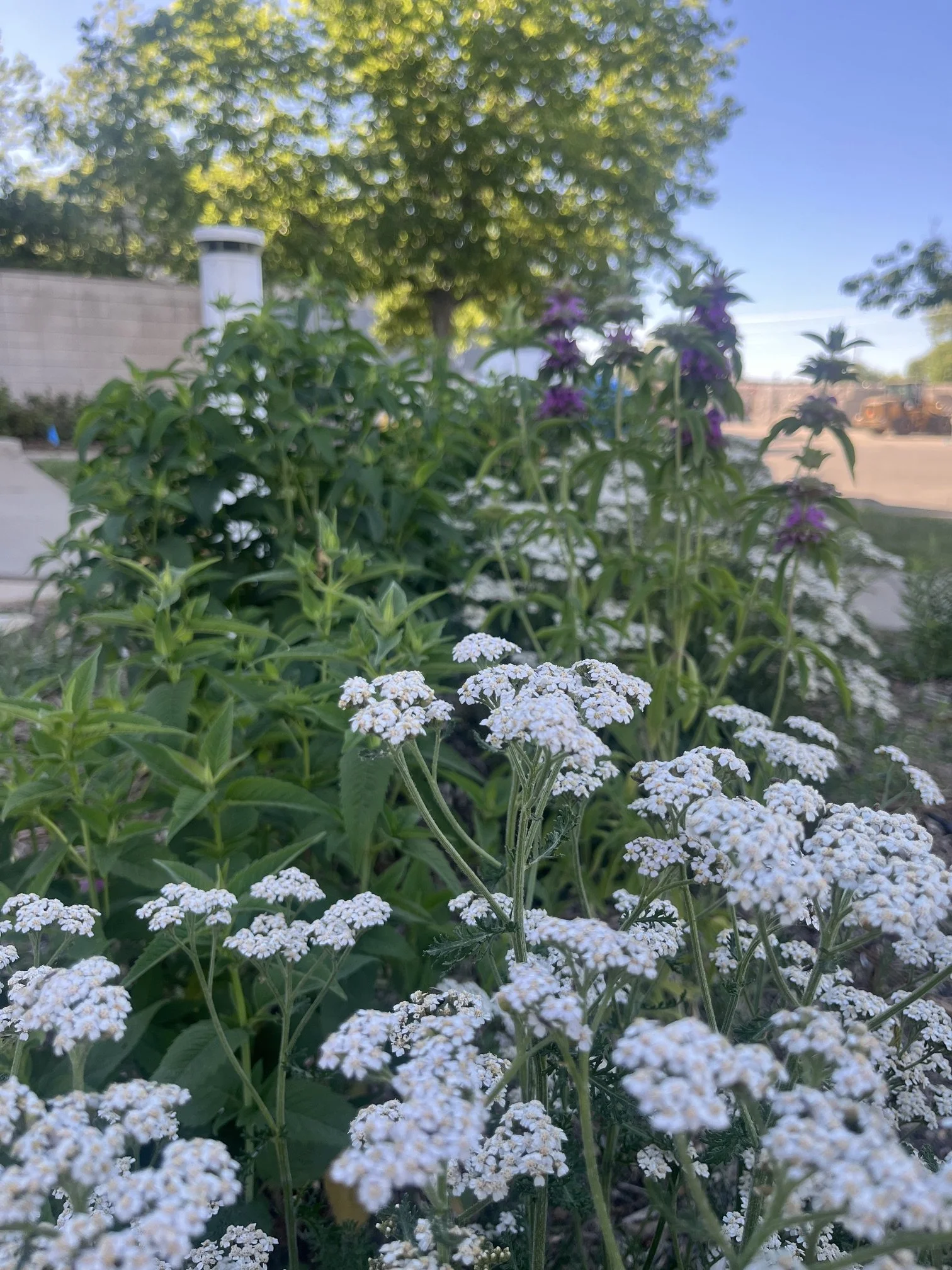
By spring, the plants began coming back. Then they began filling in. Then they flowered.
And by summer, the garden was beautiful.
Not “beautiful for a drought-tolerant landscape.” Not “beautiful considering the weather.” Just beautiful.
That distinction matters to us, because somewhere along the way, water-wise landscaping became associated with sacrifice. We have been taught to imagine a choice between the lush, abundant garden and the responsible one. Remove the lawn, the thinking goes, and what replaces it must be sparse: rock, gravel, a few ornamental grasses, perhaps three shrubs floating in a sea of mulch.
We don't think those should be the only choices available to us.



Removing the lawn is only the beginning
We talk a lot about turf removal at Larkspur, especially as communities across the Front Range grapple with water use, hotter summers, and increasingly unpredictable precipitation. But simply getting rid of grass isn't enough.
What replaces it matters.
A lawn is remarkably simple. It generally occupies one height, offers relatively little habitat, and requires us to repeatedly mow and irrigate it to keep it looking the way we've decided it should look. There are absolutely places where turf earns its keep: playgrounds, parks, gathering spaces, a patch for children or dogs. We aren't interested in eliminating every lawn.
But look around our communities and you'll find enormous amounts of grass that no one ever walks on, we call that non-essential turf.
Grass along parking lots. Grass filling wide front yards that are never used. Narrow strips beside roads. Large commercial landscapes whose primary purpose seems to be giving someone something to mow.
Those spaces represent an enormous opportunity.
At the Recycling Center, the 2,500 square feet formerly occupied by turf now holds layers of flowers, grasses, shrubs, roots, stems, seeds, and habitat. When rain does fall, the rain garden helps slow and receive it. As plants mature, their foliage shades the soil and their roots move deeper into the ground. Flowers provide nectar and pollen. Seed heads become food. Stems and plant material left standing through winter create shelter.
The landscape is still beautiful, but beauty is no longer its only job.
That, to us, is one of the most exciting things about ecological design. A garden can delight a human being while simultaneously being useful to something else.
Native plants can create abundance
One of the misconceptions we would most like to leave behind is the idea that native or xeric landscapes need to look empty.
Colorado has an extraordinary palette of plants. Our natives evolved alongside the temperature swings, dry air, wind, soils, insects, and wildlife of this region. They can give us flowers and movement, soft textures and dramatic seed heads, spring emergence and winter structure. Used densely and thoughtfully, they can produce gardens that feel generous and layered rather than a moonscape.
The Boulder Recycling garden is a good example of this approach. Its ecological statistics are AWESOME: 88% Colorado native, 97% pollinator and native bee support, 95% butterfly support, 84% bird food and habitat, but those numbers aren't the first thing most people notice when they see the garden.
They notice the flowers.
They notice the texture.
They notice that it feels alive.
And we think that's important. Ecological gardening does not work if people believe they have to choose between their values and the landscape they want to live with. The goal isn't to shame people into accepting an uglier yard because it's “better for the environment.” The goal is to make landscapes that are so beautiful, dynamic, and full of life that the ecological benefits become part of what makes them irresistible.
This is what lawn removal can become
The before-and-after photographs of this project are probably the simplest way to explain why we care so much about this work.
This used to be grass.
Where one relatively uniform surface once existed, there are now more than 200 plants. There are flowers feeding insects, seeds that will feed birds, stems providing habitat, and roots occupying the soil. Visitors to the Recycling Center can watch the garden change throughout the year and see, in a very tangible way, what a more water-conscious Front Range landscape can look like.
And this garden is still young.
That's maybe the most exciting part.
Perennial gardens evolve. Plants expand, reseed, knit together, move around, and begin to find their places. A garden at one year old is only starting to show us what it wants to become. We look at the Recycling Center today and think it's beautiful. We also know what it could look like in three years, or five.
Now imagine this happening throughout our neighborhoods.
A 2,500-square-foot garden by itself isn't going to repair the Front Range. But landscapes don't exist in isolation. A pollinator garden outside a public building connects, however imperfectly, to a native planting in someone's front yard. That connects to a school garden, a planted hellstrip, an open-space corridor, a park, another backyard.
Habitat begins to appear in pieces.
Those pieces begin to form a network.
Restoration doesn't have to mean returning thousands of acres to some untouched version of the past. In developed places, restoration can also happen in small decisions: what we plant around a mailbox, what replaces a lawn, what we allow to stand through winter, whether we choose another ornamental from somewhere else or a plant that has relationships with the insects living here.
That is why lawn removal feels so hopeful to us.
It isn't really about removing something.
It's about asking what could live there instead.
At the Boulder County Recycling Center, 2,500 square feet that once required mowing and irrigation is becoming a layered, flowering landscape that feeds insects, supports birds, manages water, and gives people an opportunity to see Colorado plants in action.
Less lawn, yes.
But more importantly: more life.
And every time we look at the before photograph, we have the same reaction:
This used to be grass.